Whoopi Goldberg’s Pope Leo XIV Comments Renew Debate Over Faith, Free Speech and Public Life
Meta description: Whoopi Goldberg’s recent remarks about Pope Leo XIV have reignited discussion about faith, politics, free speech and the role of religious leadership in modern public life.
Whoopi Goldberg has once again placed Pope Leo XIV at the center of a wider cultural conversation, after sharing her thoughts on the newly historic pontiff and the growing public interest surrounding his leadership.
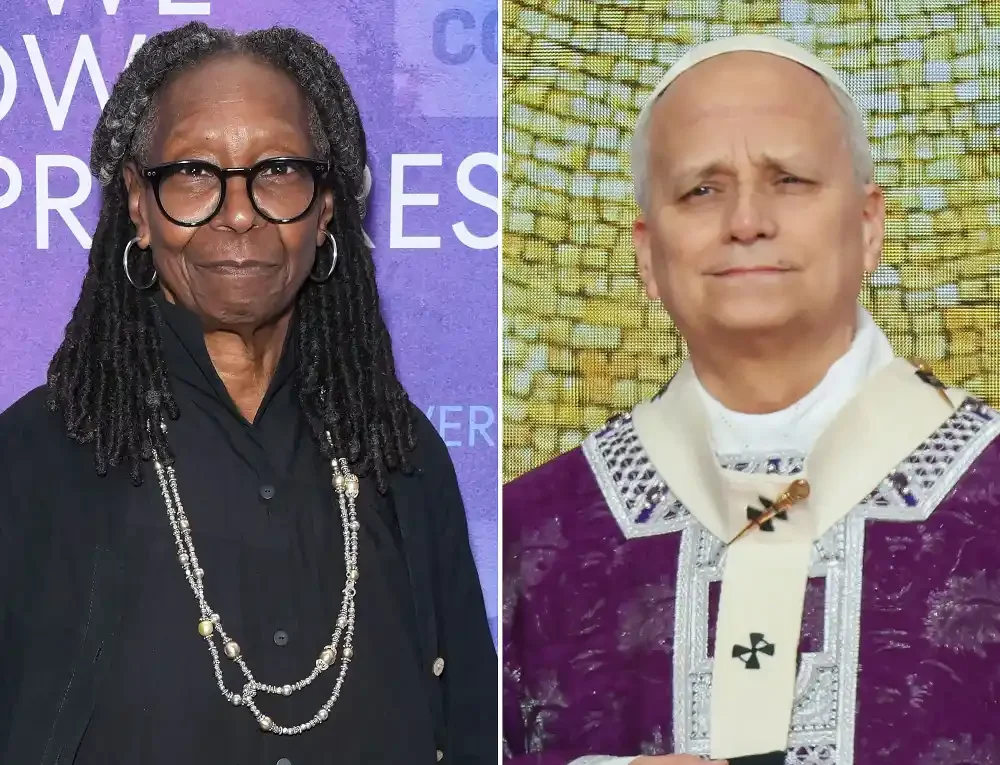
The longtime co-host of The View recently said she would welcome Pope Leo XIV at the show’s famous “Hot Topics” table, telling Us Weekly that she would like to see him “asking people questions” and sitting down for a direct conversation with the panel. Her comments came as Pope Leo XIV continues to draw attention not only from Catholics, but also from political commentators, media figures and viewers who see his papacy as a major moment in both religious and public life. (Us Weekly)
Goldberg’s remarks stood out because Pope Leo XIV is not just another global religious leader. Born Robert Francis Prevost, he was elected on May 8, 2025, becoming the 267th Successor of Saint Peter, the first pope from the United States and the first Augustinian pope in Church history, according to the Vatican’s official biography. (Vatican)
That background has made his papacy especially significant in the United States, where conversations about religion, politics, identity and free speech often overlap. Goldberg, who has spoken openly over the years about faith, inclusion and public responsibility, appears to view Pope Leo XIV as a figure whose words carry weight far beyond the walls of the Vatican.
On The View, Pope Leo XIV has already become a recurring topic. Goldberg and her co-hosts have discussed his views on peace, public morality and political leadership. In one April episode, Goldberg defended the pope’s right to speak on global issues, emphasizing that as the first American pope, he has the same free speech rights as anyone else. (Us Weekly)
Her comments come at a time when Pope Leo XIV has been making headlines for his own statements on communication, journalism and peace. Shortly after his election, he addressed thousands of journalists in Rome and called for the release of imprisoned journalists around the world. He also urged the media to reject what he described as the “war of words and images,” calling instead for communication rooted in peace and human dignity. (KSAT)
That message appears to have resonated with Goldberg, whose career has long placed her at the intersection of entertainment, politics and social commentary. For some viewers, her praise of Pope Leo XIV reflects an appreciation for a religious leader willing to speak about justice, truth and responsibility in a divided world. For others, the discussion has raised familiar questions about whether daytime television should weigh so heavily into matters of faith and theology.
Either way, the conversation has grown larger than a single comment.
Part of the reaction stems from the unusual cultural position Pope Leo XIV now occupies. As the first American pope, his words are being interpreted not only through a Catholic lens, but also through the lens of American political debate. His statements on peace, journalism and public speech have drawn attention from people who may not regularly follow Vatican affairs.
Goldberg’s remarks have added another layer to that attention. By suggesting that Pope Leo XIV would make a compelling guest on The View, she framed him not as a distant religious figure, but as someone who could participate in the kind of open, unscripted public conversation that defines modern media.
That idea has sparked strong reactions online. Supporters praised Goldberg for recognizing the pope’s moral influence and willingness to engage difficult subjects. Critics argued that conversations involving the pope should be treated with greater seriousness and less entertainment-style commentary. The divide reflects a broader tension in public life: religious leaders are increasingly discussed not only in churches and official statements, but also on talk shows, podcasts and social media feeds.
Goldberg is no stranger to conversations about the Vatican. She previously met Pope Francis and publicly praised his emphasis on compassion, inclusion and humanity. Her interest in Pope Leo XIV appears to follow that same thread: an admiration for religious figures who speak to people beyond institutional boundaries.
Pope Leo XIV’s early papacy has already shown signs of that broader outreach. His emphasis on free speech, imprisoned journalists and peaceful communication has positioned him as a global moral voice at a time when public debate often feels hostile and fragmented.
Goldberg’s comments may not have changed Church policy or political reality, but they have helped bring Pope Leo XIV’s message into mainstream entertainment conversation. That alone shows how much influence both figures hold in their respective worlds.
For Pope Leo XIV, the challenge will be continuing to speak with clarity while leading one of the world’s oldest institutions. For Goldberg, the moment reinforces her role as a television personality willing to bring religion, politics and culture into the same conversation.
And for the public, the debate shows no sign of slowing down. As Pope Leo XIV continues defining his papacy, every statement from him — and every high-profile reaction to him — is likely to keep drawing attention far beyond the Vatican.