After Charlie Kirk’s killing at age 31, public grief spread quickly across America. But the aftermath also showed how emotion, rumor, and political division can collide online.
The phrase “only 31” carries a weight that statistics never can. It is not just an age. It is a reminder of unfinished years, unwritten chapters, and a life cut short before its natural time.
After conservative activist Charlie Kirk was killed during a public event at Utah Valley University, the country entered a familiar but painful cycle: shock, mourning, anger, political argument, and a flood of online posts trying to define what the tragedy meant. For his supporters, Kirk’s death felt like the loss of a powerful voice. For others, even those who strongly disagreed with his politics, the killing was a disturbing reminder that public life in America has become dangerously tense.
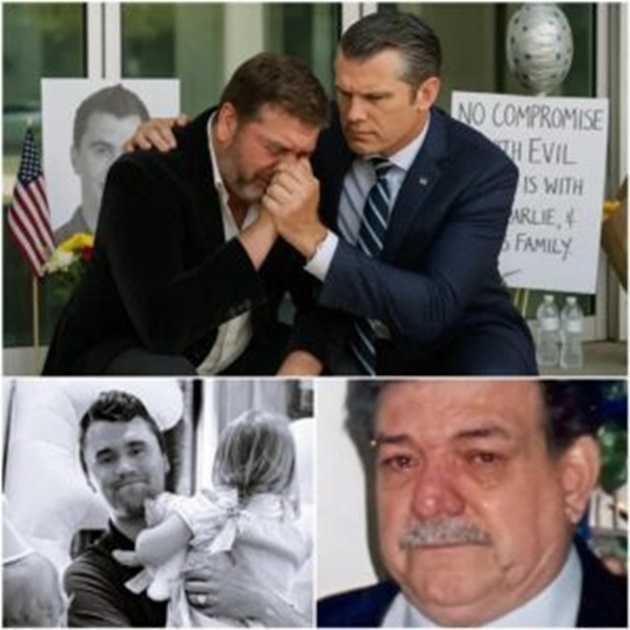
In moments like this, grief often moves faster than facts. Within hours, emotional stories, edited images, dramatic captions, and viral claims began spreading across social media. Some posts focused on the pain of a grieving father. Others placed well-known public figures, including Pete Hegseth, into highly emotional scenes of comfort and collapse. The stories were written to make readers stop scrolling, feel something immediately, and share before asking whether the details were true.
That is the danger of tragedy in the age of viral content. Real pain becomes mixed with imagined scenes. Genuine mourning becomes packaged like entertainment. A heartbreaking death becomes the center of stories designed less to inform than to provoke.
Pete Hegseth’s role in the aftermath was not simply about emotion. As a prominent public figure and Defense Secretary, his response became part of the broader national conversation about political violence, public responsibility, and institutional discipline. In the wake of Kirk’s killing, attention turned not only to the act itself, but also to how Americans reacted to it online. Public officials warned against celebrating or mocking violence, especially among those serving in positions of public trust.
That message matters. A nation cannot survive if political disagreement becomes a justification for cruelty. It cannot heal if death becomes a punchline. And it cannot protect democracy if assassination, intimidation, or public celebration of violence becomes normalized.
At the same time, the public also has a responsibility to protect the truth. Mourning does not require exaggeration. A real tragedy does not need a fabricated scene to become meaningful. Charlie Kirk’s age, the public nature of his death, and the deep reaction it caused were already powerful enough. Adding unverified claims only damages the credibility of those trying to honor the moment.
The most responsible way to remember a public tragedy is to separate three things: the verified facts, the emotional response, and the political interpretation. The facts tell us what happened. The emotional response tells us how deeply people were affected. The political interpretation belongs to public debate. But when those three become confused, misinformation spreads easily.
That confusion is exactly what happened with several viral posts after Kirk’s death. The phrase “he was only 31” became a symbol of grief. But some posts attached that phrase to dramatic claims that were not supported by reliable reporting. They described scenes of collapse, famous figures offering comfort, and emotional moments that could not be verified. Many readers shared them because they felt true emotionally, even when the evidence was missing.
This is how misinformation survives: not always through obvious lies, but through stories that match what people already feel.
Still, the larger grief was real. Across the country, people responded to Kirk’s killing with sorrow, fear, anger, and reflection. Supporters mourned a man they saw as courageous and influential. Critics of his politics still condemned the violence. Parents saw a young father. Public speakers saw a warning. Students and universities saw the vulnerability of open events in a polarized age.
The aftermath also forced a harder question: how should Americans speak about those they oppose?
Political disagreement is not new. It is part of democratic life. But democracy requires a moral boundary. That boundary is crossed when opponents are treated as enemies to be destroyed rather than citizens to be challenged. Once violence enters the political arena, every side becomes less safe.
Kirk’s death became a test of public character. Some responded with compassion. Some responded with anger. Some used the moment to score political points. Others used it to spread viral stories that were too dramatic to verify. The best response is neither silence nor sensationalism. It is sober truth.
A young public figure was killed. A family was left to grieve. A movement lost one of its most visible voices. A country already divided was forced to look again at the consequences of hatred, dehumanization, and reckless speech.
That is enough.
There is no need to invent a father collapsing. There is no need to turn mourning into a staged scene. There is no need to make tragedy more dramatic than it already is.
“Only 31” is powerful because it is simple. It reminds people that behind every political headline is a human life. Behind every public figure is a family. Behind every act of violence is a wound that spreads far beyond the person killed.
In the end, the most decent response is also the most difficult one: grieve honestly, speak carefully, verify before sharing, and refuse to celebrate violence no matter whose side the victim was on.
America does not need more viral grief. It needs more truth, more restraint, and more humanity.