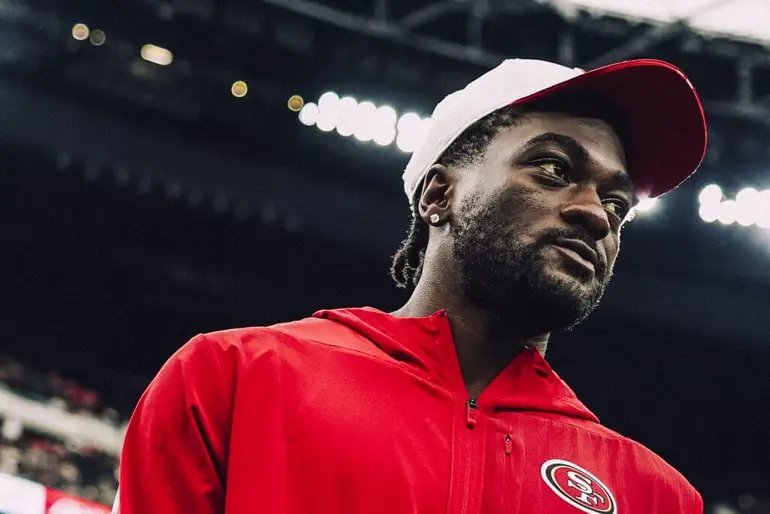
Brandon Aiyuk’s situation with the San Francisco 49ers has moved from contract drama to full uncertainty. What once looked like a long-term partnership now feels like a slow-moving separation, with the wide receiver’s future stuck between injury recovery, contract complications, and a trade market that has not fully opened.
Aiyuk has not played since October 20, 2024, when he suffered a serious knee injury against the Kansas City Chiefs. Reports have described the injury as involving a torn ACL and MCL, and his recovery has stretched far beyond the original optimism surrounding his return. That injury came only months after Aiyuk and the 49ers agreed to a four-year, $120 million contract extension, a deal that was supposed to end months of tension between the two sides. Instead, it became the beginning of a new chapter of uncertainty. (NBC Sports Bay Area)
The relationship became even more complicated when the 49ers voided Aiyuk’s guaranteed money for the 2026 season. Head coach Kyle Shanahan confirmed that the team had voided the guarantees, though he did not publicly go into the specific reasons behind the decision. NFL.com reported that the guarantees were listed at around $27 million, and that the move made a potential separation easier if the two sides could not repair the relationship. (NFL.com)
For San Francisco, the issue is no longer just whether Aiyuk is talented enough to keep. His talent is not really the debate. Before the injury and contract fallout, Aiyuk was one of the team’s most productive offensive players. He posted a 1,000-yard season in 2022 and followed it with an even better 2023 campaign, catching 75 passes for 1,342 yards and seven touchdowns. That production helped him earn his big extension, but the events that followed have changed the calculation. (NFL.com)
The 49ers appear ready to move on, but moving on has not been simple. General manager John Lynch has publicly suggested the team is open to trade calls, but no deal has materialized. According to 49ers Webzone, Lynch told teams, “Give us a call,” after the 2026 NFL Draft, signaling that San Francisco would listen to offers. The problem is that potential trade partners may prefer to wait for the 49ers to release Aiyuk instead of giving up draft compensation and taking on his existing contract. (49ers Webzone)
That is where the standoff begins.
San Francisco does not want to simply release Aiyuk if it believes another team has interest. Interested teams, meanwhile, may not want to trade for him if they think he could become available for free. NBC Sports Bay Area reported that the Washington Commanders have been linked to Aiyuk, partly because of his relationship with quarterback Jayden Daniels, his former Arizona State teammate. NFL Media’s Ian Rapoport described the situation as a waiting game, with the 49ers hoping for a trade and other teams possibly waiting for a release. (NBC Sports Bay Area)
The Commanders make sense on paper. Daniels is a rising franchise quarterback, and Aiyuk would give Washington another high-level receiving option if healthy. The personal connection between Aiyuk and Daniels adds another layer to the speculation. But a trade is not just about fit. It is about money, health, communication, and risk.
One of the biggest obstacles is Aiyuk’s contract. Any team trading for him would need to be comfortable with the financial commitment or would need to negotiate a reworked deal. That appears difficult right now. ESPN’s Adam Schefter said teams have had trouble reaching Aiyuk, and that the communication issue has become part of the reason a trade has not happened. If a team cannot speak clearly with the player about his health, contract expectations, and willingness to report, it becomes much harder to justify giving up assets. (49ers Webzone)
The 49ers also have a timing advantage. They do not have to rush. According to 49ers Webzone, San Francisco’s key deadline is September 1, when Aiyuk’s option bonus is due. Until then, the team can wait to see whether another franchise becomes desperate enough to offer something in return. (49ers Webzone)
That patience may be strategic, but it also keeps everyone in limbo. Aiyuk remains tied to a team that appears prepared to move on. The 49ers remain responsible for managing an unresolved situation around a player who was once expected to be a core offensive piece. Potential trade partners remain hesitant because they may not want to inherit the contract or risk giving up compensation for a player still working back from a major injury.
So what comes next?
There are three realistic outcomes.
The first is a trade. This is San Francisco’s preferred path because it would allow the team to recover some value instead of losing Aiyuk for nothing. However, a trade likely requires three things: a team willing to take the risk, Aiyuk willing to communicate and cooperate, and a contract structure that makes sense for the acquiring club.
The second outcome is a release. This may become more likely if no team offers acceptable compensation. A release would allow Aiyuk to choose his next destination, and it could increase interest from teams that do not want to trade for his current deal. Washington would immediately become a team to watch if that happens.
The third outcome is the least likely but still possible: Aiyuk stays with the 49ers. That would require a major reset in the relationship. Given the voided guarantees, the trade speculation, and the public sense that both sides are preparing for separation, a reunion would be difficult. Still, the NFL has seen damaged relationships repaired before when talent, money, and need line up.
For now, Aiyuk’s career is paused at a strange intersection. He is too talented to ignore, too expensive to casually acquire, too injured to evaluate easily, and too complicated contractually for a clean resolution.
The 49ers once paid him like a centerpiece. Now they are waiting for someone else to make a move. Until that happens, Brandon Aiyuk remains one of the NFL’s most fascinating unresolved stories — a star receiver caught between what he has already proven and what teams are still willing to risk.