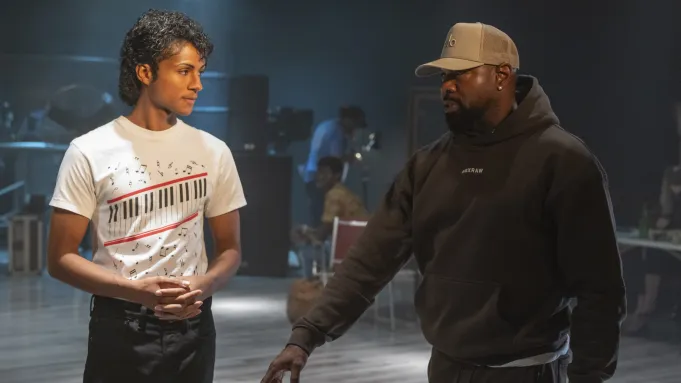
Antoine Fuqua’s Michael has arrived as one of the most talked-about music biopics in years, not only because of Michael Jackson’s unmatched cultural legacy, but also because of the complicated questions surrounding how any film should portray the pop icon’s life.
In a new interview, Fuqua discussed the making of the Lionsgate film, including a conversation he once had with Michael Jackson, the difficult reshoots that reshaped the movie, the possibility of a sequel, and the creative choices made around Jackson’s controversies. The film stars Jaafar Jackson, Michael’s nephew, in the lead role and follows the singer’s rise from child star in the Jackson 5 to global superstardom.
The movie has already made a major commercial impact. Michael opened with an estimated $97 million in the U.S. and Canada and $217.4 million worldwide, setting a new opening-weekend record for a music biopic. (AP News)
For Fuqua, the project was never just another celebrity biography. It was a high-pressure attempt to capture the discipline, loneliness, brilliance and spectacle of one of the most famous entertainers in modern history. The director, known for films such as Training Day and The Equalizer, stepped into unfamiliar territory with a story built around music, legacy and public memory.
One of the most personal elements Fuqua addressed was a past conversation he had with Jackson himself. While the filmmaker has not presented the movie as a simple tribute, that encounter appears to have shaped the way he viewed Jackson as both a performer and a human being. Fuqua’s approach centers on the artist’s drive, vulnerability and extraordinary control over his craft, while also acknowledging that Jackson’s legacy remains deeply contested.
The most debated part of Michael is what the film does not include. The finished movie ends in 1988, before the sexual abuse allegations that later became central to public debate about Jackson. Jackson denied wrongdoing during his lifetime, his estate continues to deny the allegations, and he was acquitted in his 2005 criminal trial. (AP News)
That ending was not always the plan. According to reporting, the movie originally included material connected to the 1993 allegations involving Jordan Chandler, but the filmmakers later had to remove that storyline because of restrictions tied to a prior legal settlement. The change forced major edits and reshoots, with the third act reworked so the film would conclude during Jackson’s Bad era. (AP News)
The result is a film that focuses heavily on Jackson’s rise, his family dynamics, his perfectionism, his physical transformation, his health struggles and his record-breaking career. It recreates defining moments such as the Jackson 5’s early success, the Motown years, the moonwalk, the Thriller phenomenon and the 1984 Pepsi commercial accident.
Critics, however, have questioned whether the film is too sanitized. Some argue that a movie about Jackson cannot responsibly avoid the allegations that shaped the final decades of his public image. Others see the film as a portrait of a specific time period, ending before those events entered the public record.
Fuqua has defended the film’s structure by pointing to the period it covers, while also suggesting that Jackson’s later life contains enough material for another movie. That has made sequel talk unavoidable. Lionsgate has already indicated interest in continuing the story, and Fuqua has made clear that he would want to remain involved if another installment moves forward. (The Guardian)
A sequel would face an even more difficult creative challenge. If the first film is about Jackson’s ascent, a second would likely have to confront the controversies, legal battles, tabloid scrutiny, career decline, comeback attempts and final years leading up to his death in 2009. Avoiding those subjects would be far harder in a movie set after 1988.
Still, the box-office response suggests that audiences remain intensely interested in Jackson’s story. Despite poor-to-mixed reviews, moviegoers have responded strongly, with the film earning an A- CinemaScore. (AP News)
At the center of that response is Jaafar Jackson, whose performance has been one of the film’s most widely praised elements. As Michael’s nephew, Jaafar brings a family connection to the role, but the performance also required him to recreate some of the most recognizable movements, mannerisms and vocal qualities in pop history.
Fuqua’s gamble was that audiences would accept Jaafar not simply as an impersonator, but as a dramatic lead capable of carrying the emotional weight of Jackson’s early life. Based on the film’s opening weekend, that gamble appears to have paid off commercially.
The larger debate around Michael is far from settled. For fans, the movie is a long-awaited celebration of an artist who changed music, dance, fashion and the global entertainment business. For critics, it raises uncomfortable questions about authorized biopics, estate involvement and whether commercial storytelling can fully engage with painful public allegations.
What is clear is that Fuqua’s Michael has become more than a movie. It is now part of the continuing argument over how Michael Jackson should be remembered: as a once-in-a-generation performer, a deeply troubled celebrity, a controversial public figure, or all of those things at once.
With a sequel now in discussion, Fuqua and the studio may soon have to decide how far they are willing to go into the darker and more divisive chapters of Jackson’s life. The first film chose spectacle, rise and legacy. The next one, if it happens, may not have the option of looking away.